The short answer: if you searched for a “physio” in Kyoto, here is the thing worth knowing before you book anywhere — the words do not map cleanly between your country and Japan.
- In Japan, physiotherapist (理学療法士) is a protected national title. Only people who hold the national licence may use it.
- In the Japanese healthcare system, physiotherapy normally happens inside a hospital or clinic, after a doctor has referred you. Walking in off the street for a sports physio session, the way you might at home, is not how the public system is set up.
- In Japan, “osteopath” is not a protected title. There is no national licence for it, so training behind the word varies enormously from one place to another.
- The two professions are close cousins in what they do with their hands, and further apart than you would expect in how they are regulated.
So the useful question is not “physio or osteopath?” It is: who is in front of me, what were they actually trained in, and can they work in English?
What “physio” means where you come from
United Kingdom. Physiotherapist is a protected title, regulated by the HCPC. Most people reach one through the NHS or privately, and self-referral is normal. Sports physio is a familiar, walk-in kind of service.
Australia and New Zealand. Similar picture. Physiotherapists are first-contact practitioners. You book directly.
United States. The equivalent is a Physical Therapist, usually DPT-trained. Direct access exists in some form in every state, though the details vary.
In all of these, “I’ll go see a physio about my back before the match” is an ordinary sentence. That expectation is what travels with you to Japan.
What “physiotherapist” means in Japan
Japan’s physiotherapists are licensed under the Physical Therapists and Occupational Therapists Act (Act No. 137 of 1965), with the national examination administered under the Ministry of Health, Labour and Welfare. The title is name-protected: using it without the licence is not permitted.
The structural difference is access. In the Japanese public medical system, a doctor sees you first and then refers you for physical therapy. Direct access is not the norm; physiotherapists may act as first contact mainly in preventive settings rather than for an acute back complaint.
What this means in practice for a visitor:
- Most physiotherapists in Japan work in hospitals and rehabilitation departments, not in walk-in sports clinics.
- Getting to one usually means seeing a physician first — appointment, referral, and Japanese-language paperwork.
- On a short trip, that route is often slower than the reason you wanted it.
This is not a criticism of the system. It simply answers a question a lot of visitors ask us: why can’t I just book a physio here?
What “osteopath” means where you come from
United Kingdom. Osteopathy is regulated by statute. The Osteopaths Act 1993 created the General Osteopathic Council, which has kept a statutory register since 2000. “Osteopath” is a protected title, and osteopaths are primary-contact practitioners — no referral needed.
Europe. Regulation varies by country. Some have brought osteopathy into statutory regulation; others have not.
United States. This is where the confusion multiplies. A DO (Doctor of Osteopathic Medicine) in the US is a fully licensed physician with the same practice rights as an MD. That is a different profession from the manual-therapy osteopath you would see in Britain or Europe. Same root, two branches, and in practice they function as separate professions.
So an American reading “osteopath” and a British reader reading the same word are picturing two different appointments.
What “osteopath” means in Japan
There is no national licence for osteopathy in Japan, and no protected title. Anyone may use the word.
That has an obvious consequence: the training behind the sign on the door can be anything from a UK bachelor’s degree to a weekend course. The word alone tells you very little.
If you are choosing a place in Japan, these are the things actually worth checking:
- Where was the practitioner trained, and for how long? A UK or European osteopathy degree is four to five years, full time.
- Is there a named qualification you can look up? BSc(Ost), MOst, DO from a recognised programme.
- Can they work in your language? Hands-on work depends on you being able to describe what you feel and say stop.
- Do they explain what they are doing and check as they go?
What is actually licensed in Japan
Japan does license several hands-on professions by national examination. Knowing which is which makes the signs on the street much easier to read.
Licensed by national examination:
- Anma massage shiatsu therapist, acupuncturist, and moxibustion therapist — licensed under Act No. 217 of 1947. They may run their own practice.
- Judo therapist (柔道整復師) — licensed under Act No. 19 of 1970. These are the 接骨院 and 整骨院 you see on almost every block, working with acute injuries such as sprains, bruises, dislocations and fractures. Part of that work can be claimed against public health insurance.
- Physiotherapist (理学療法士) — licensed under Act No. 137 of 1965.
Not licensed in Japan:
- Osteopathy, chiropractic and 整体 (seitai) have no national licensing system. Japan groups them under 医業類似行為 — practices adjacent to medicine.
The physiotherapy licence has one feature worth spelling out, because it is unusual by international standards. A Japanese physiotherapy licence does not carry the right to open an independent practice. Physical therapy in the legal sense is carried out under a physician’s direction, which is why almost all physiotherapists in Japan work inside hospitals and rehabilitation departments rather than in clinics you can walk into.
We have written separately on how osteopathy differs from chiropractic, which is the other word people mix in.
Quick comparison
| Physiotherapist (Japan) | Osteopath (Japan) | Osteopath (UK) | DO (USA) | |
|---|---|---|---|---|
| National licence | Yes (理学療法士) | No | Yes (GOsC) | Yes — physician |
| Title protected | Yes | No | Yes | Yes |
| Referral needed | Usually, in the medical system | No | No | No |
| Typical setting | Hospital, rehab department | Private practice | Private practice, some NHS | Full medical practice |
| How to check credentials | National licence | Ask where they trained | GOsC register | State medical board |
On a phone, scroll the table sideways to see all five columns.
So which one do I actually need?
Honest version: for most of the everyday complaints visitors bring us — a stiff upper back, low back pain after long flights and futons, a neck that seized up on day three — the two professions overlap a great deal in what they would do in the room.
Where they differ is emphasis. Physiotherapy in Japan leans towards structured rehabilitation and loading programmes over a course of sessions, often after a medical diagnosis. Osteopathy leans towards looking at how the whole body is organised around the part that hurts, and working with your hands-on session time rather than a prescribed programme.
What matters more than the label, for a short stay:
- How quickly can you be seen?
- Can the session run in your language?
- Will they tell you honestly if what you have is not something hands-on work is right for?
On that last point: if something you describe suggests you need a doctor rather than a session, we will say so and point you to emergency options. That is the answer nobody markets, and it is the one that matters most.
How this works at OQ
Kyoto Osteopathy Center OQ has been open since February 2007 — the original osteopathy clinic in Kyoto — two minutes’ walk from Hankyu Omiya Station. We have two practitioners, and they are genuinely two different professions under one roof.
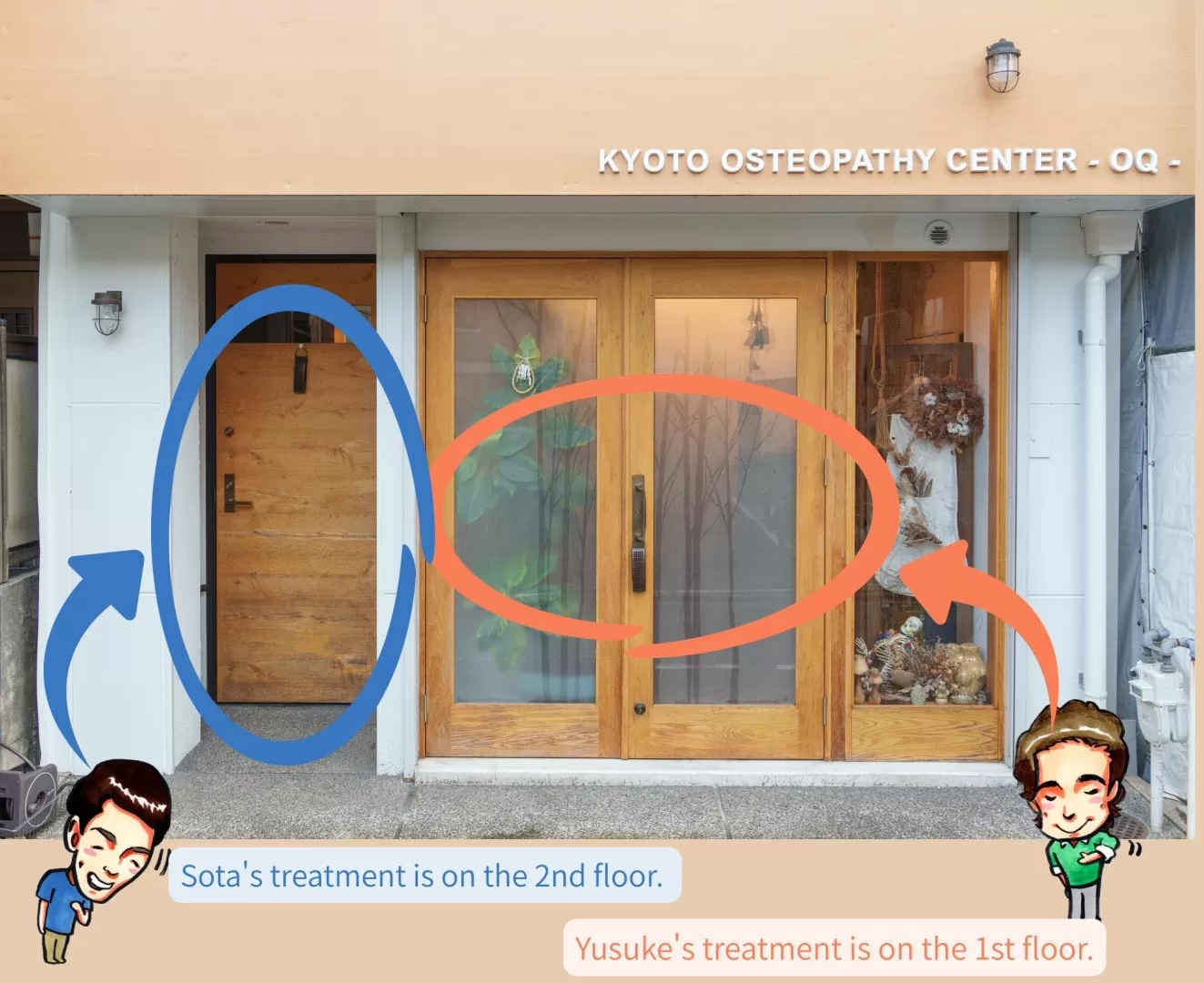
Yusuke Sakata — osteopath, BSc(Ost), ground floor (🟧 orange sign).
Trained at Swansea University in Wales. Osteopathy only. Sessions run entirely in English. This is where most international patients are seen — including pregnancy and post-surgical work.
Sota Omura — second floor (🟦 blue sign).
Sota holds the Japanese national physiotherapy licence and an MSc. Because of the rule described above, what he does here is not “physical therapy” in the insurance sense — these are private-pay, hands-on sessions, and his licence is the training behind them rather than the framework they run under. His focus is the lower limb, gait, and stroke rehabilitation. He works without thrust techniques.
There is no clicking in his sessions — more on that in our honest answer on joint clicking. Sota works mainly in Japanese with English support, and Yusuke bridges where it matters; if you want the whole session to run in English, that is Yusuke.
If you searched for a physio and what you want is gait, knee, hip or post-stroke rehabilitation work, Sota is the Japanese-licensed physiotherapist. If you want hands-on osteopathy in English, that is Yusuke. Tell us what you are dealing with and we will say which of us fits — including saying “neither, see a doctor first” when that is the answer.
No referral is needed. Sessions are private-pay and are not covered by Japanese public health insurance.
If you plan to claim through travel or private insurance, please check with your insurer first about what they require — policies differ a great deal. We can give you a simple receipt at no charge. If your insurer needs more than that — a detailed written report of the session, or their own claim form filled in — we can prepare it for a document fee of ¥8,800.
If you would like to know what a session looks like before you commit, we have written out what happens on a first visit.
FAQ
Is there a physiotherapist in Kyoto I can book directly in English?
Direct booking with a Japanese-licensed physiotherapist outside the hospital system is uncommon, because physical therapy in Japan normally follows a doctor’s referral. At OQ, Sota Omura holds the national physiotherapy licence and sees patients privately on the second floor; Yusuke Sakata sees international patients in English on the ground floor as an osteopath.
Is osteopathy regulated in Japan?
No. There is no national licence or protected title for osteopathy in Japan, so it is worth asking where a practitioner trained. Yusuke Sakata holds a BSc(Ost) from Swansea University in Wales.
Is a Japanese osteopath the same as a US DO?
No. A DO in the United States is a fully licensed physician. Osteopaths trained in the UK and Europe are manual-therapy practitioners and do not prescribe or perform surgery.
Is 整体 (seitai) the same as osteopathy?
No. Seitai is a separate category with no national licence and no defined relationship to osteopathic training.
Do I need a referral?
No. You can book directly.
Can I be seen at short notice?
Often yes. Same-day and next-day slots come up; message us and we will tell you honestly what is open.
Visiting
Kyoto Osteopathy Center OQ
466 Shichikencho, Nakagyo-ku, Kyoto 604-8366
2 minutes from Hankyu Omiya Station
Tel: 075-822-3003
Reception 9:00–22:30 (last booking 21:30)
Established February 2007
🟧 Ground floor, orange sign — Yusuke Sakata (osteopathy)
🟦 Blue sign, second floor — Sota Omura (physiotherapy)
Clothes to change into are provided, so come as you are.
- Intake form: https://o-q.jp/intake/
- Booking: https://kyotoosteo.simplybook.asia/v2/
- Map: Google Maps
✍️ Written by Yusuke Sakata, Director, BSc(Ost) — Bachelor of Science in Osteopathy, Swansea University, Wales, UK. EVOST. The Institute of Classical Osteopathy. Cranial Academy (USA) 40-hour cranial programme. Mind & Membrain certified practitioner. Over 25 years in clinical practice, working with children, pregnancy, post-surgical recovery and whole-body concerns.