“How many sessions will I need?” is usually the first thing people ask us. It’s a fair question.
Think about renovating a home. You’d sit down with the builder, talk about what you want the place to feel like, and then ask: “How long will this take?” If the answer was “No idea,” you probably wouldn’t hire them.
So we always give you an estimate. Here’s how we work it out.
Most visitors come once or twice. Read what a single session can do →
Your body does the repairing
Nobody tells a cut on your finger to close. Your body gathers the cells, stops the bleeding and rebuilds the skin on its own. A plaster just keeps things out of the way.
Osteopathy works on the same idea. We don’t fix you. We look for what is getting in the way of your body’s own repair, and help clear it. That takes some time, because the body changes at its own pace, not ours.
Re・Form: the first stage
At OQ, the first stage of care has a name: Re・Form, as in renovating a home that has been lived in for years.
- It usually takes 6 to 12 sessions, 7 or 8 on average. That estimate is based on 40-minute sessions.
- We start with about three sessions, once a week or once every two weeks.
- By the third session, we’ll tell you what we expect: roughly how many more, and what we’re aiming for.
Why not give you a number on day one? A good builder looks under the floor and checks the pipes before quoting. Your first sessions are our survey: we see how your body responds before we plan the rest.
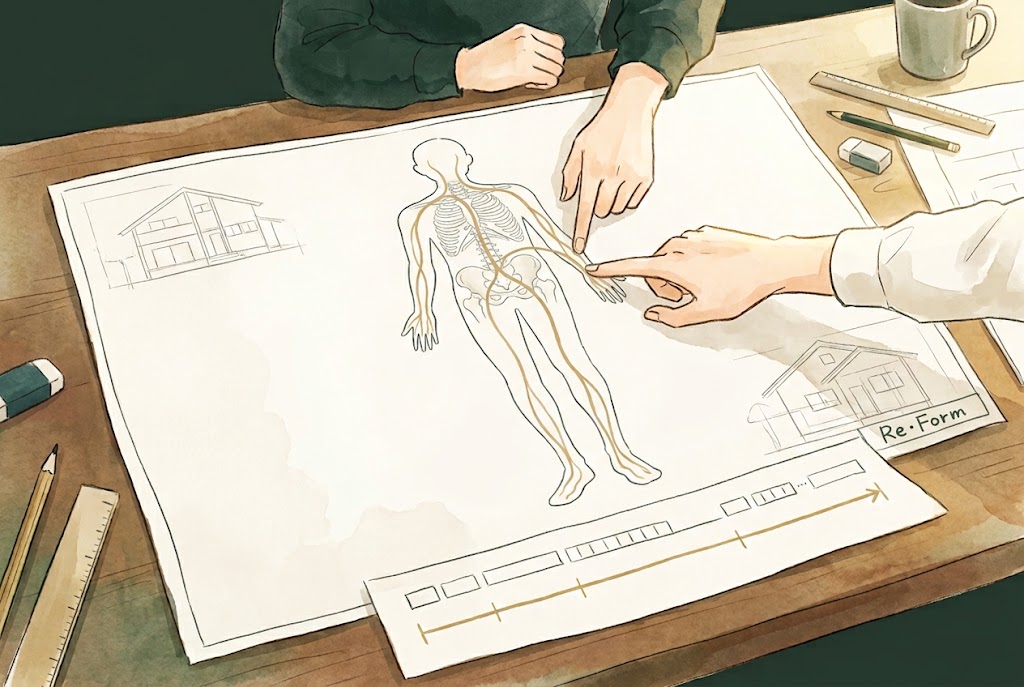
A five-year-old house and a seventy-year-old house
The same renovation can be a very different job.
If you’ve lived with a problem for many years, had several operations or accidents, been through a serious illness, or are older, the 6–12 estimate may not apply. Then we plan in months rather than sessions, and go at your body’s pace.
After a stroke, or a hip or knee replacement, you’ll usually work with Sota Omura over a longer period. Besides hands-on work, the body needs time to relearn standing and walking.
How long is a session?
- Yusuke Sakata (Director, ground floor): 40 minutes is standard. We suggest 60 minutes for an occasional maintenance session, or when we judge that more time is needed. For some people who live nearby, we may suggest shorter sessions, closer together, at the start.
- Sota Omura (Co-Director, one floor up): 60 minutes, at the same fee as Yusuke’s 40. Sota has ten years of clinical experience as a physiotherapist and has trained in osteopathy for fewer years than Yusuke, so he takes more time to reach the same point. He uses that time for exercise guidance and checking how you move.
Full fees are on our home page: Fees →
Is a longer session better?
Not necessarily. It’s natural to compare sessions by the minute. But what we watch is how much your body can take in on that day. Once the work it needs is done, we stop. More time on the table doesn’t mean more change.
Shorter sessions also give you time back. Walk home slowly. Rest. Spend the rest of the day with a body that has just started to settle.
And some days you simply want to be looked after for a long time. That’s what a good massage therapist or spa does best, and we’d happily suggest one.
OQ is for when you want your body to work better. Even so, osteopathy has its own kind of comfort. The touch is light; something deep in the body lets go. Plenty of people fall asleep on the table. It’s a different feeling from being kneaded, closer to your body settling on its own.
After Re・Form: maintenance
Once the first stage is done, you come when you feel you need it, a bit like visiting your hairdresser.
Some people come every few months for 60 minutes. Some who live nearby come twice a month for a shorter session. Others come at the change of seasons. If you can, a session every three to six months, even when nothing is wrong, makes it easier to catch things early.
We’re not trying to keep you coming
We don’t sell blocks of sessions or memberships. The aim of Re・Form is that you need us less, not more.
Getting to know OQ Step 4 of 6: How long will it take?
NextWho will I see? Our practitioners
Two osteopaths, two floors. Which of us should you see?Book onlineMessage us on WhatsApp
Questions first are welcome. No pressure to book.
This page is based on the clinical experience of Yusuke Sakata (BSc(Ost)), Director, and Sota Omura, Co-Director, at Kyoto Osteopathy Center OQ. AI was used for part of the drafting, and Yusuke Sakata reviewed the content before publication.